comrade_lecter: (Default)
There is a misconception that nonbinary people are "fake trans", don't transition otherwise than socially, or detransition. Here's what I can say on this issue.

This is the only study that focused on brain differences between binary and nonbinary people that was conducted, and it validates their existence:
https://www.ncbi.nlm.nih.gov/m/pubmed/22364652/

Here's something on how they transition:

"Chest surgery for nonbinary patients comprises a considerable proportion of transgender surgery practice"
https://www.ncbi.nlm.nih.gov/m/pubmed/30007346/

"assigned female at birth non-binary people, who do not feel themselves to be men, are, in increasing numbers, using exogenous testosterone."
https://www.researchgate.net/publication/334777012_Reworking_Testosterone_as_a_Man's_Hormone_Non-binary_People_using_Testosterone_within_a_Binary_Gender_System

"Finally, the only study analyzing the effects of medical interventions on health of NBGQ individuals (i.e., third research question) found that NBGQ FAAB individuals, contrary to the belief that they would not need to medically affirm their gender, improved their quality of life and health after chest surgery (Esmonde et al., 2018). This result is in line with previous studies which found that both hormonal treatment (e.g., Newfield et al., 2006) and chest surgery (e.g., Agarwal et al., 2018) commonly improved the quality of life and well-being of female-to-male transgender individuals."
https://www.ncbi.nlm.nih.gov/pmc/articles/PMC6603217/

"Overall, non-binary youth (13%) were significantly less likely than binary youth (52%) to access hormone therapy, but they were more likely than binary youth to report experiencing barriers to accessing hormone therapy when needed."
https://www.researchgate.net/publication/322364079_Non-binary_youth_Access_to_gender-affirming_primary_health_care

"49% of non-binary individuals also desired hormone therapy, although only 13% of these individuals had received it, relative to 71% of binary individuals."
https://www.researchgate.net/publication/335459665_Comparing_the_health_of_non-binary_and_binary_transgender_adults_in_a_statewide_non-probability_sample

Apparently nonbinary trans people are accepted by theoretical science, but still face difficulties with practical medicine and everyday life.

"Non-binary adolescents experienced myriad forms of invalidation within multiple social contexts, which contributed to negative affective and cognitive processes, including confusion, self-doubt, rumination, and internalized shame. For many participants, the cumulative stressors related to invalidation contributed to poor mental health outcomes. Data from this study suggest that identity invalidation is a unique form of minority stress that may especially affect non-binary individuals, with significant implications for their social and emotional well-being."
https://www.researchgate.net/publication/332994345_Invalidation_Experiences_Among_Non-Binary_Adolescents

The stereotype that nonbinary people don't transition is a kind of a self fulfilling prophecy, because it leads to their medical needs being invalidated and denied. But in general, linking one's validity as a trans person to their transition is a toxic practice, since many binary trans people can't transition either. "Trans" isn't short for "transition". The word "transsexual" initially was reserved for people with a desire to have different sexual roles and/or anatomy, that included gay people (https://www.etymonline.com/word/transsexualism), and it was coined a decade before first sex change operation was conducted. Applied strictly to gender, "trans" means identifying outside of your assigned status (that's true for both "transgender" https://www.merriam-webster.com/dictionary/transgender#other-words and "transsexual" https://www.merriam-webster.com/dictionary/transsexual). Which can include nonbinary people too.
comrade_lecter: (Default)
""The results show that many of the genes situated on the Y chromosome are expressed in various parts of the brain prior to birth and probably provide a developmental basis for the sex-based differences exhibited by adult brains," according to Elena Jazin.

More than a third of Y-chromosomal genes appear to be involved in sex-based human brain differentiation. Some of the genetic activity in question is evident in the adult brain, while other of it only appears at earlier stages of brain development. It is yet unknown whether the differences in genetic expression among female and male brains have any functional significance."

(source: http://www.uu.se/en/news/news-document/?id=801&area=2,3,16&typ=pm&lang=en)

"The aim of this study was to investigate sex-related differences in the prenatal development of early oral, lingual, pharyngeal, and laryngeal motor activities. Sonographic images of oral-upper airway regions were observed in 85 healthy fetuses (43 males, 42 females; mean gestational age 24wks 3d [SD 0.69]; range 15-38wks). Biometric data on morphologic development and associated motor patterns were compared across second and third trimesters. Results showed that while males and females demonstrated statistically similar patterns of general physical growth (p>0.05), significant differences in development of specific lingual and pharyngeal structures were present (p<0.05). Significant differences were found for laryngeal and pharyngeal motor activity, and oral-lingual movements (p<0.05). Complex oral-motor and upper airway skills emerged earlier in females, suggesting a sex-specific trajectory of motor development. It was concluded that differential patterns of prenatal motor development may be important in defining sex-specific indices of oral skill maturation."

(source: https://www.ncbi.nlm.nih.gov/pubmed/16700938)

"Sex is determined by two chromosomes: men have one X chromosome and one Y chromosome, while women have two X chromosomes. The Y chromosome contains the SRY gene, which triggers a flood of androgens (the group of hormones that includes testosterone) sometime between six and twelve weeks of gestation, guiding the development of the penis and testes. But this fetal testosterone bath also makes its mark on the brain’s architecture, resulting in sexually dimorphic brain circuits."

(source: http://dana.org/News/Details.aspx?id=43520#_edn1)

"In the study, Verma and colleagues, including co-authors Ruben C. Gur, PhD, a professor of psychology in the department of Psychiatry, and Raquel E. Gur, MD, PhD, professor of Psychiatry, Neurology and Radiology, investigated the gender-specific differences in brain connectivity during the course of development in 949 individuals (521 females and 428 males) aged 8 to 22 years using diffusion tensor imaging (DTI). <...> In the study, the researchers found that females displayed greater connectivity in the supratentorial region, which contains the cerebrum, the largest part of the brain, between the left and right hemispheres. Males, on the other hand, displayed greater connectivity within each hemisphere. By contrast, the opposite prevailed in the cerebellum, the part of the brain that plays a major role in motor control, where males displayed greater inter-hemispheric connectivity and females displayed greater intra-hemispheric connectivity."

(source: https://www.pennmedicine.org/news/news-releases/2013/december/brain-connectivity-study-revea)

"On average, males have larger grey matter volume in bilateral amygdalae, hippocampi, anterior parahippocampal gyri, posterior cingulate gyri, precuneus, putamen and temporal poles, areas in the left posterior and anterior cingulate gyri, and areas in the cerebellum bilateral VIIb, VIIIa and Crus I lobes, left VI and right Crus II lobes. Females on average have larger volume at the right frontal pole, inferior and middle frontal gyri, pars triangularis, planum temporale/parietal operculum, anterior cingulate gyrus, insular cortex, and Heschl's gyrus; bilateral thalami and precuneus; the left parahippocampal gyrus and lateral occipital cortex (superior division)."

(source: https://www.sciencedirect.com/science/article/pii/S0149763413003011)

"During the intrauterine period a testosterone surge masculinizes the fetal brain, whereas the absence of such a surge results in a feminine brain. As sexual differentiation of the brain takes place at a much later stage in development than sexual differentiation of the genitals, these two processes can be influenced independently of each other. Sex differences in cognition, gender identity (an individual’s perception of their own sexual identity), sexual orientation (heterosexuality, homosexuality or bisexuality), and the risks of developing neuropsychiatric disorders are programmed into our brain during early development. There is no evidence that one’s postnatal social environment plays a crucial role in gender identity or sexual orientation. We discuss the relationships between structural and functional sex differences of various brain areas and the way they change along with any changes in the supply of sex hormones on the one hand and sex differences in behavior in health and disease on the other."

(source: https://www.sciencedirect.com/science/article/pii/S0091302211000252)

"Regardless of sexual orientation, men had almost twice as many somatostatin neurons as women (P < 0.006). The number of neurons in the BSTc of male-to-female transsexuals was similar to that of the females (P = 0.83). In contrast, the neuron number of a female-to-male transsexual was found to be in the male range. Hormone treatment or sex hormone level variations in adulthood did not seem to have influenced BSTc neuron numbers. The present findings of somatostatin neuronal sex differences in the BSTc and its sex reversal in the transsexual brain clearly support the paradigm that in transsexuals sexual differentiation of the brain and genitals may go into opposite directions and point to a neurobiological basis of gender identity disorder."

(source: https://academic.oup.com/jcem/article/85/5/2034/2660626)

"Antonio Guillamon‘s team at the National University of Distance Education in Madrid, Spain, think they have found a better way to spot a transsexual brain. In a study due to be published next month, the team ran MRI scans on the brains of 18 female-to-male transsexual people who’d had no treatment and compared them with those of 24 males and 19 females.

They found significant differences between male and female brains in four regions of white matter – and the female-to-male transsexual people had white matter in these regions that resembled a male brain (Journal of Psychiatric Research, DOI: 10.1016/j.jpsychires.2010.05.006). “It’s the first time it has been shown that the brains of female-to-male transsexual people are masculinised,” Guillamon says.


In a separate study, the team used the same technique to compare white matter in 18 male-to-female transsexual people with that in 19 males and 19 females. Surprisingly, in each transsexual person’s brain the structure of the white matter in the four regions was halfway between that of the males and females (Journal of Psychiatric Research, DOI: 10.1016/j.jpsychires.2010.11.007). “Their brains are not completely masculinised and not completely feminised, but they still feel female,” says Guillamon."

(source: https://www.newscientist.com/article/dn20032-transsexual-differences-caught-on-brain-scan/)


(source: http://transascity.org/the-transgender-brain/)

"Transgender women tend to have brain structures that resemble cisgender women, rather than cisgender men. Two sexually dimorphic (differing between men and women) areas of the brain are often compared between men and women. The bed nucleus of the stria terminalus (BSTc) and sexually dimorphic nucleus of transgender women are more similar to those of cisgender woman than to those of cisgender men, suggesting that the general brain structure of these women is in keeping with their gender identity. <...>

(source: http://sitn.hms.harvard.edu/flash/2016/gender-lines-science-transgender-identity/)

"Sexual differentiation of genitals take place in the first 2 months of pregnancy. Sexual differentiation of brain takes place in the second half of pregnancy. It is found that there is structural sex differences in the central nucleus of the bed nucleus of the stria terminalis (BSTc). Structural differences were found to be reversed in transsexual people. In humans main mechanism appears to involve a direct effect of testosterone on the developing brain. Direct effect of testosterone on developing brain in boys and lack of this effect in girls are crucial factors in the development of male and female gender identity. The origin of transsexuality is based on the fact that the differentiation of sexual organs takes place before the sexual differentiation of the brain. It was found a reversal in BSTc. In men this area is twice the size of that in women. In male-to-female transsexuals they found female BSTc."

(source: https://www.endocrine-abstracts.org/ea/0037/ea0037EP208.htm)

"A growing twin-based literature supports genetic influence on gender identity development. An international survey of adult transsexual twin pairs reported transition concordance values of 33.3 % (13 ∕ 39) for identical [monozygotic (MZ)] male pairs and 22.9 % (8 ∕ 35) for MZ female pairs. By contrast, transition concordance values for fraternal [dizygotic (DZ)] male and female twins were zero or approached zero (1 ∕ 36), consistent with genetic influence. Here, we report the first case of transsexualism in both reared apart brothers of a male-to-female MZ twin pair.

One twin (AT) committed suicide at age 35 years; therefore, interviews were conducted in 2012–2013 with the surviving co-twin (LT) at age 50 years. Prior to AT’s death, DNA testing had confirmed the twins’ monozygosity, as did a twin-typing questionnaire administered to LT. […]

LT learned that he had a twin at the age of 15 when his mother revealed this secret information inadvertently. When the twins were 15.5 years of age, LT’s mother arranged a reunion. Prior to meeting, by age 8 years both twins experienced gender discomfort, engaged in cross-dressing, and felt that they should have been born as the other gender. Also prior to meeting, both twins experienced unease with the anticipated and actual secondary sexual development of puberty. Furthermore, unbeknownst to his twin, at age 14 years LT was fully committed to undergoing sex reassignment surgery and so convinced his mother that she took him to see an urologist. Thus, both twins met the diagnostic criteria of the fifth edition of the Diagnostic and Statistical Manual (DSM-5) for gender dysphoria, in particular persistent cross-gender identification and a strong desire to change the sexual characteristics to those of the other gender.

Genetic effects on transsexuality are strongly indicated by this unique case study. The nature and extent of family support also affect the behavioral adjustment of transsexual individuals, as evidenced by LT’s more favorable outcome and AT’s tragic outcome."

(source: http://hawaii.edu/PCSS/biblio/articles/2010to2014/2014-identical.html)
comrade_lecter: (Default)
I noticed that on this site I am the only one who listed "truscum" or "tucute" as an interest, and it made me think about my difficult relationships with these terms and their objective value (or lack of such).

When I for the first time seriously tried on the transgender label, I was 18. It's not like I never thought about being another gender before, but I was convinced it is supposed to go with much larger discomfort than I experienced. So I was relieved to find out nonbinary genders exist, and I classified myself as genderfluid, as it matched my periodical strong discomfort with my body and periodical feelings that I can actually enjoy it. I had no idea about the complexity of trans inner politics, but I guess my earlier position was tucute-like - learning about gender being a spectrum made me stop believing any dysphoria is necessary.

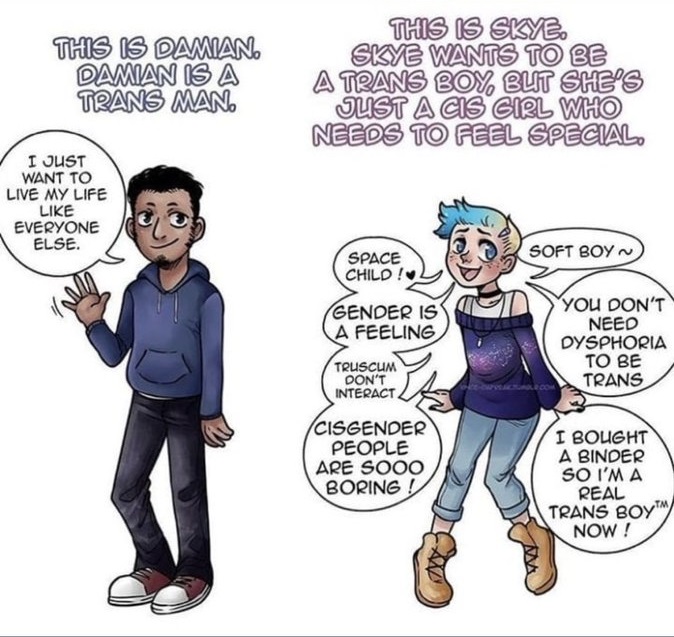
Gradually I educated myself. I shared political space with people who did not believe in trans at all, and I needed scientific sources to back myself up. I learned about sex differences in the brains and about how trans people appear as a result of mismatch between brains and genitals, and how it all expresses itself via dysphoria. This is how I developed my first conscious view on trans issues, and I called myself a transmedicalist, while still identifying as genderfluid. It did not present much of a problem on deviantart, but I faced some backlash on tumblr. Fitting in the tumblr transmed community was difficult, I was too left leaning, and quite a few were "skeptical" of my gender. At that point my dysphoria got worse. Looking back, I can see that I subconsciously tried to prove myself I'm valid, and I wanted to feel worse. Even though the transmed community on tumblr was vocally against linking dysphoria to self hate, there was still a lot of pressure towards trans men who found some parts of their bodies enjoyable of engaged in feminine activities. Selfies on guys with make-up posted in trans male tags always gathered negative comments, calling them "trenders", cis girls. Popular transmed artists drew comics picturing true trans men as traditionally masculine and "trenders" as gender non conforming and flamboyant. Like this:

It all created an unhealthy environment that pushed mentally weak people (such as myself and most of my transmed friends at that point) towars hurting themselves and others. I'm not saying it all to paint transmeds as evil, now my opinion is that they are both the perpetrators and the victims. But now I'm happy I left.

I left soon after publicly announcing that I'm male. I couldn't handle my colleagues all gathering to protect an actual transphobe (a person who claimed trans women can't be lesbians, etc) from fair criticism just because she did a good job angering SJWs and was what they called a "free thinker". For a long time after that I still held transmed views. I thought about rebranding it as transmaterialism, a movement that would basically be the same, but without any other politics influencing it, but our number never went farther than 4. For a long time I dropped trans discourse altogether.

Now I'm beginning to question my previous beliefs even more, and I seem to lean closer to my original position. There is some solid, well documented proof that transgenderism is a neurological condition linked to brain sex. But I haven't yet seen anything that would state it must cause gender dysphoria in 100% of the cases. Transmeds often start war at DSM, APA, and other official papers and organizations for being too pro tucute and not putting a heavy enough emphasis on dysphoria. But time taught me that in most cases doctors are actually right. Transmeds like saying that with new, less severe criteria for medical transition there is a growing problem of trenders going on hormone replacement therapy, and then having to detransition, but there is no medical records of such a process.

Is transmedicalism just a collective illusion of hurt and insecure people? From what I know, might as well be so.
comrade_lecter: (Default)
I decided I will repost my old trans science posts here, so I won't have to clog my WordPress (which I'll leave for map stuff only).

So, Post 1 - the "mass detransition" hoax.

The studies are grouped by years.

2005

“After treatment the group was no longer gender dysphoric. The vast majority functioned quite well psychologically, socially and sexually. Two [out of 162] non-homosexual male-to-female transsexuals expressed regrets.”

(source: https://www.cambridge.org/core/journals/psychological-medicine/article/sex-reassignment-outcomes-and-predictors-of-treatment-for-adolescent-and-adult-transsexuals/D000472406C5F6E1BD4E6A37BC7550A4)

2006

“The subjects proclaimed an overall positive change in their family and social life. None of them showed any regrets about the SRS.”

(source: https://www.sciencedirect.com/science/article/pii/S1158136006000491)

2010

“There were 15 (5 MF and 10 MF) regret applications corresponding to a 2.2% regret rate for both sexes. There was a significant decline of regrets over the time period.”

(source: https://www.ncbi.nlm.nih.gov/pubmed/24872188)

2014

“Following surgery, 63 of 103 patients (61.2%) were satisfied with their outward appearance as women, and a further 27 (26.2%) were very satisfied (Figure 1). 45.5% (n = 50) were very satisfied with the gender reassignment surgery process, 30% (n = 33) satisfied, 22.7% (n = 25) mostly satisfied, and 1.8% (n = 2) dissatisfied”

(source: https://www.ncbi.nlm.nih.gov/pmc/articles/PMC4261554/)

“No patient (0%) regretted starting genital-GCS surgery.”

(source: https://www.ncbi.nlm.nih.gov/pubmed/26816764)

2015

“Gender dysphoria is effectively alleviated by sex reassignment treatments. Quality of life is improved among the majority of patients, and regrets are rare.”

(source: https://www.ncbi.nlm.nih.gov/pubmed/26237928)

2018

“All but one patient (97.5%) reported no regrets about having undergone surgery, and the majority recommended it to other patients with gender dysphoria.”

(source: https://www.ncbi.nlm.nih.gov/pubmed/29101439/)

“Most transgender men and women who satisfy WPATH eligibility criteria experience improved quality of life, overall happiness, and sexual function after GCS; regret is rare.”

(source: https://www.ncbi.nlm.nih.gov/pubmed/29454634)

“Postoperative satisfaction was 94% to 100%, depending on the type of surgery performed. Eight (6%) of the participants reported dissatisfaction and/or regret, which was associated with preoperative psychological symptoms or self-reported surgical complications (OR = 6.07). Satisfied respondents’ QoL scores were similar to reference values; dissatisfied or regretful respondents’ scores were lower. Therefore, dissatisfaction after GAS may be viewed as indicator of unfavorable psychological and QoL outcomes.”

(source: https://www.ncbi.nlm.nih.gov/m/pubmed/28471328/)

March 2023

S M T W T F S
   1234
567891011
12131415161718
1920 2122232425
262728293031 

Syndicate

RSS Atom

Most Popular Tags

Style Credit

Expand Cut Tags

No cut tags
Page generated Jan. 6th, 2026 10:27 pm
Powered by Dreamwidth Studios